Team patterns
Team patterns
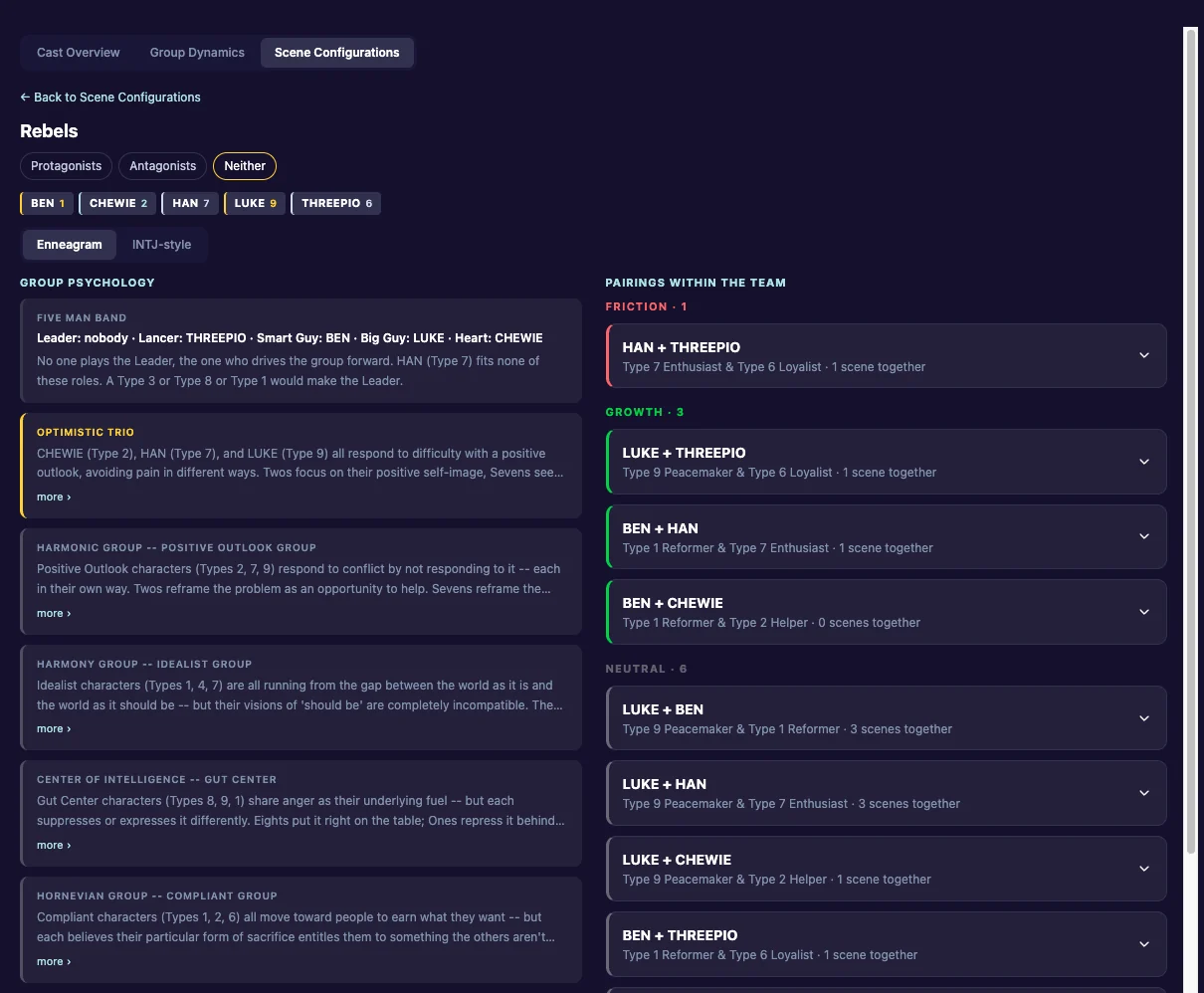
Storytellers have built ensembles the same few ways for centuries: the odd couple, the trio of instinct, reason and conscience, the band of five. When you save a team, Group Analysis checks it against these classic patterns. It shows who plays which role, which roles are empty or doubled, and where the team’s main conflict runs, so you can make a good team better.
Patterns appear at the top of Group Psychology on a saved team’s page. To save a team, see Scene Configurations and teams.
Which patterns you’ll see
| Team | Lens | Pattern |
|---|---|---|
| 2 members | Enneagram | Red Oni, Blue Oni |
| 3 members | Enneagram | Freudian Trio |
| 4 members | INTJ-style | Four Temperaments |
| 5 members | Enneagram | Five Man Band |
| 6 or more | either | Sixth Ranger |
| any size | INTJ-style | Quadras; introverts and extraverts |
| a Protagonists team and an Antagonists team | either | Evil mirror |
For the patterns that depend on types, every member of the team needs a type in that lens. Until they do, the card tells you to categorize the rest.
Red Oni, Blue Oni
The odd couple: one runs hot, one runs cool. Each one’s strength is the other’s blind spot, so every scene can turn on the gap between them.
- Hot (Red Oni): Types 2, 4, 6, 7 and 8.
- Cool (Blue Oni): Types 1, 3, 5 and 9.
If both run hot, expect fast escalation with no one to slow it down. If both run cool, their scenes can stay polite and low-stakes. Either way, the card says which type would restore the contrast.
Freudian Trio
Three roles, named after Freud’s model of the mind:
- Id: acts on emotion and instinct. Types 7, 8 and 4.
- Superego: acts on rules, logic and principle. Types 1, 5 and 6.
- Ego: reconciles the other two and makes the final call. Types 9, 3 and 2.
The Id and the Superego clash, and the Ego is caught in the middle. If a role is empty or two members compete for one, the card says so and names the types that would complete the trio.
Five Man Band
Five roles:
- Leader: drives the group forward. Types 3, 8 or 1.
- Lancer: challenges the Leader. Types 4, 6 or 8.
- Smart Guy: figures out the problem. Types 5 or 1.
- Big Guy: the muscle. Types 9 or 8.
- Heart: holds the group together. Types 2 or 9.
The card gives each member the role their type fits best. It flags any role nobody fills, any member who competes with another for the same role, and any member who fits none of them, with the types that would fill each gap.
It also reads the band’s main conflict thread, Leader against Lancer:
- a friction pairing runs hot all story long;
- a growth pairing challenges each other and ends up making each other better;
- a neutral pairing may need pushing to stay alive.
Four Temperaments
A team of four with one Rational, one Idealist, one Guardian and one Artisan covers every need: Mastery, Meaning, Duty and Freedom. Each member wants something the others don’t, so the conflict is built in and nobody is redundant. If a temperament is missing, the card names the pressure that will never come from inside the team; if two members share one, it says they compete for the same role. See INTJ-style types in a group.
Quadras
A team inside one Quadra shares the same values, so friction inside the team stays low and the conflict has to come from outside, or from one member breaking ranks. A team that spans Quadras disagrees about what matters, not only how to get it.
Introverts and extraverts
The extraverts drive scenes and speak first; the introverts hold back and decide later. Watch for the introverts being overruled, or quietly holding the real power. A team of only extraverts risks noise; a team of only introverts lets tension build in silence.
Sixth Ranger
On a team of 6 or more, the member who shares the fewest scenes with the rest is the outsider: the late arrival, the reluctant ally, or the one who might walk away. Their pairings with the core team show whether they will be welcomed or resented. The card only appears when one member clearly stands apart.
Evil mirror
When one saved team is marked Protagonists and another Antagonists, each team’s page compares the two, member by member. Each hero is matched with the villain who shares their type (same fear, same drive, opposite side), or failing that the same Enneagram center or INTJ-style temperament. The match shows what each hero could become. Anyone without a mirror is listed too.
