What Group Dynamics shows you
What Group Dynamics shows you
Drama lives in what happens between people. Writers already know who their characters are. What is harder to see is how a particular mix of people behaves under stress: which combinations make each other better, and which tear each other apart.
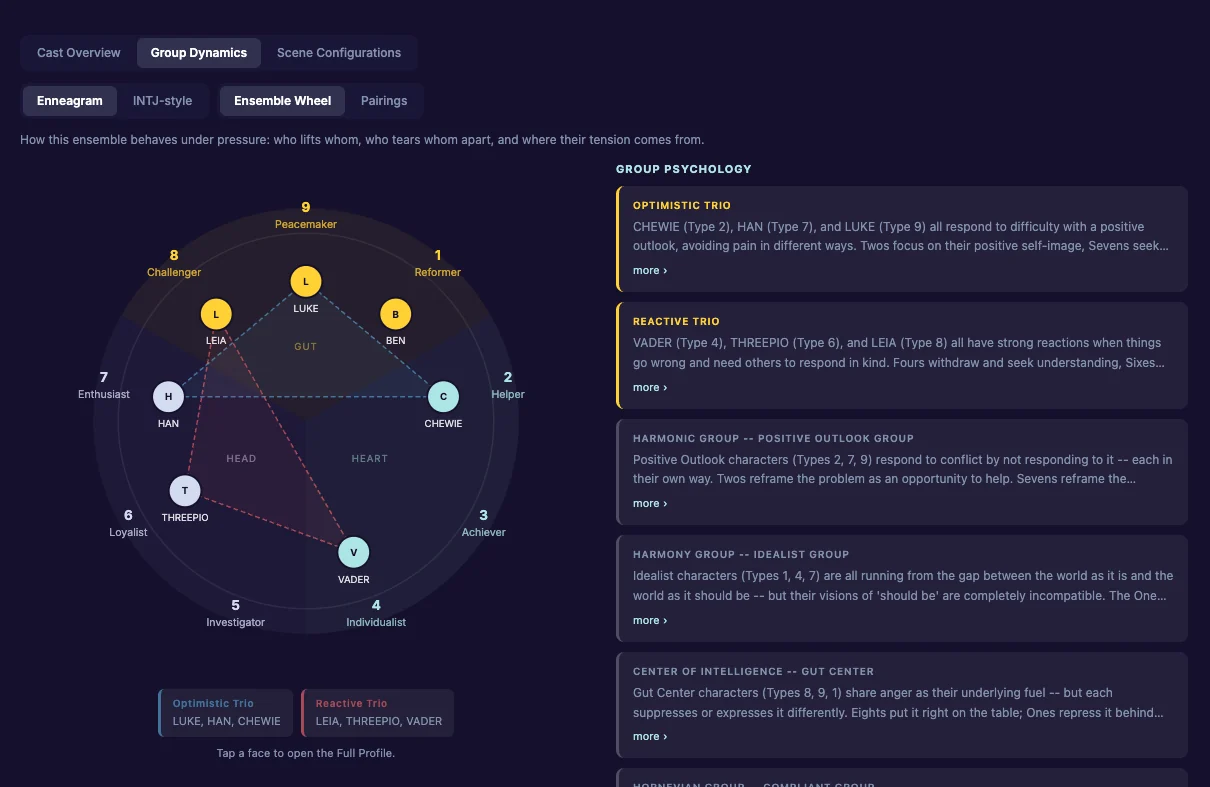
Group Dynamics is a diagnostic for your ensemble. It reads your cast as a group and shows you where the tension in your story comes from, so you can build it and keep it.
What it tells you
- Where the conflict comes from. Whether two characters clash at the level of what they fear, not only what they want.
- Which pairings spark. Every pair in your cast is marked as growth, friction or neutral, so you can see where the heat is and where the room goes quiet.
- The shape of the group. Whether the cast is balanced, or has too many fighters, too few thinkers, or nobody holding the heart.
- Which groups keep meeting. Scene Configurations finds the characters who keep sharing scenes, so you can tell a running team from a rut.
- What kind of team you have built. On a saved team, Group Analysis recognises classic ensembles, such as the Freudian Trio or the Five Man Band, and shows which roles are filled, which are empty, and where the main conflict thread runs.
How it works
- Open your story and click Characters.
- Give at least 2 characters a type. You can pick a type yourself or take a quiz as the character. See Give the app your cast’s types.
- Click the Group Dynamics tab.
- Choose a lens: Enneagram or INTJ-style.
- Choose a view: Ensemble Wheel or Pairings.
The reports fill in as you categorize more of your cast. Use them as a second read of your ensemble, not as a rulebook.
Two lenses
- Enneagram looks at what each character fears and wants, and how the 9 types pull on each other. See Enneagram types in a group.
- INTJ-style looks at how each character thinks, decides and acts under pressure, using 16 types and 4 temperaments. See INTJ-style types in a group.
You can use either lens or both. Each one reads the same cast differently.
Who can use it
Group Dynamics, Scene Configurations, the quizzes and the Full Profile are Pro features. They are always open on the Sample Story, so you can try everything there first. See Plans and the Pro trial.
